Nature's creation - the rhythm of water and the shelter of mountains
The natural landscape of Hongcun has long been meticulously designed and integrated into the living environment, jointly forming a harmonious picture.
Nanhu: The cover and frame of Hongcun
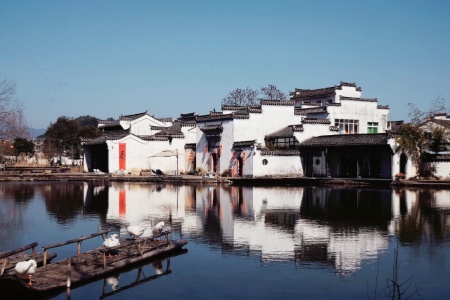
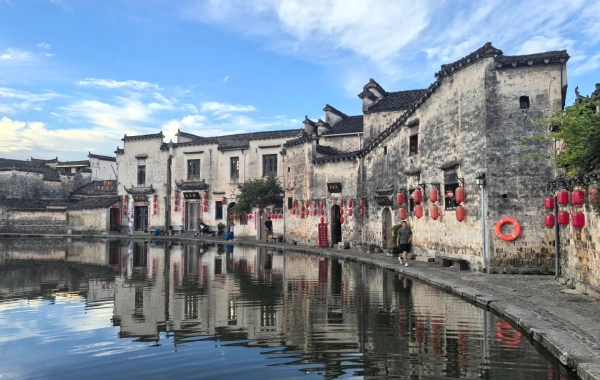
As the "cow's stomach", Nanhu Lake is the most spacious and photogenic spot in Hongcun. The lake is arched, with towering ancient trees and willows swaying over the water on the embankment. A delicate arched bridge (painted bridge) divides it. In the early morning, a thin mist swirled around, and the lake surface was like a mirror, reflecting the distant Leigang Mountain and the nearby whitewashed walls and black tiles. At dusk, the setting sun dyed the sky and the lake water warm golden. This is a sketching base for universities such as the China Academy of Art. Students can be seen painting here all year round. The integration of people and scenery is itself a dynamic painting.
Moon Marsh: The center of clan life
The crescent-shaped "Ox Stomach" moon marsh is located in the center of the village. It is not a stagnant pool of water, but is connected to the flowing water outside through irrigation canals, always clear and fresh. All around are paved with bluestone slabs. The high walls and horse-head walls of Huizhou-style architecture are neatly arranged in a circle, reflected in the pool like a bright moon that has fallen to the earth. This was once a place where villagers gathered and exchanged ideas, but now it is an excellent stage for photographers to capture the light and shadow. At night, when the lanterns are lit up, their reflections are dazzling and colorful, making the scene even more serene and profound.
Water Channel: The Rhythm of Life in the "Cow Intestines"
The irrigation canal that runs through the entire village is the lifeblood of Hongcun. The clear stream flows gently. Women are washing clothes by the water, and children are playing on the stone slabs. Walking along the water channel, one can most directly experience the convenience and poetry of "having a clear spring in front of every household", and appreciate the life wisdom of the ancients who said, "The distance to the stream for washing water is far, and there is a clear spring in front of every household."
Leigang Mountain: The feng shui pillar of the village
As the "bull's head", Leigang Mountain serves as the natural barrier and backdrop for Hongcun. The ancient trees on the mountain tower into the sky. Standing at the Leigang Pavilion on the summit, one can overlook the entire Hongcun Village, seeing the "ox-shaped" village blend seamlessly with the fields and distant mountains, and feel the ingenuity of its location and the grandeur of its layout.
Humanistic Craftsmanship - Huizhou Merchants' Mansions and Clan Imprints
Every building here is a three-dimensional textbook of Huizhou culture, carrying the ideal of merchants who love Confucianism.
Chengzhi Hall: The Luxury and craftsmanship of the "Folk Forbidden City"
The residence of Wang Dinggui, a prominent salt merchant in the late Qing Dynasty, is hailed as the "encyclopedia of Huizhou-style woodcarving craftsmanship". The entire building is grand and imposing, featuring 9 courtyards and over 60 halls. The essence lies in the wood carvings that cover the beams, lintels, brackets and window sashes. The figures, landscapes, flowers and birds, as well as the stories of operas, are all exquisitely carved and gilded with colorful paintings. The complexity and beauty are so breathtaking that they are the ultimate embodiment of the financial strength and aesthetic taste of Huizhou merchants.
Wang Clan Ancestral Hall (Le Xu Hall) : The core of the clan's power
It is located on the northern bank of the Moon Marsh and is the only ancestral hall in Hongcun. The building is solemn and dignified, serving as a venue for discussing major village affairs, implementing clan regulations, and holding celebrations. The plaque inscribed with "Shide Faxiang" on the gatehouse highlights the Wang family's emphasis on moral inheritance. Understanding it is the key to comprehending the operational logic of Hongcun as a bloodline clan society.
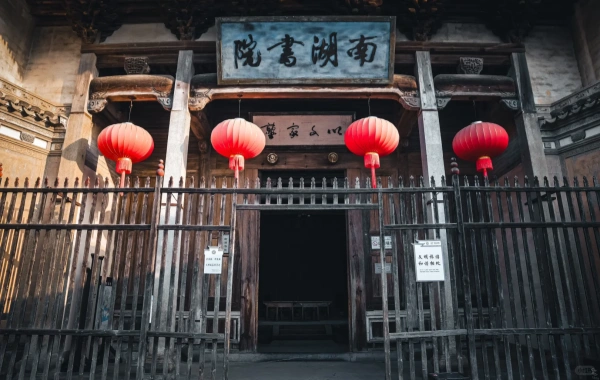
Nanhu Academy: A spiritual palace that values culture and education
Facing South Lake, it was a place for teaching and nurturing students in ancient times in Hongcun. The environment is serene and the layout is strict. It is composed of Zhidao Hall, Wenchang Pavilion, Qimeng Pavilion and so on. Walking through it, one seems to be able to hear the clear and loud reading voices of the students of the past and feel the strong literary atmosphere of Huizhou where "in a village of ten households, recitation is never neglected".
Typical residential buildings such as Shurentang and Taoyuanju:
- Shuren Hall: Meaning "cultivating talents for a hundred years", the building is simple and elegant, embodying the ideal of Confucian merchants of "nurturing culture through business and serving people through culture".
Taoyuanju: Renowned for its exquisite brick-carved gate towers, it features a rich variety of carving subjects and exquisite craftsmanship.
The numerous ancient residences such as Jingde Hall and Jingxiu Hall, each with its own unique features, together form a rich architectural lineage of Hongcun. The layout of the door canopy, courtyard, hall and side rooms vividly interprets the philosophy and beauty of the Huizhou-style architecture of "Four Waters Returning to the hall".
Photography Secrets:
The best vantage point for a panoramic view of the Nanhu Painting Bridge is on the opposite bank of the lake. In the early morning, you can capture the morning mist and reflections against the light.
The best time to photograph the Moon Marsh is half an hour after sunrise and half an hour before sunset, when the light is soft and the reflections are clear.
The details of the wood carvings in Chengzhi Hall require a macro lens, and side light should be sought to highlight the three-dimensional effect.
The composition of the ancient trees (red poplars and ginkgo trees) at the village entrance and the grand view of the village is suitable for shooting in the afternoon with the light in front.