
China Mythology
The Evolution of Chinese Mythology: From Primitive Beliefs to Cultural Symbols—A Millennial Transformation
Chinese mythology's development is not a linear progression but a dynamic interplay with social structures, political demands, philosophical currents, and artistic forms. It unfolds through four major stages—primitive faith, state mythology, religious-philosophical fusion, and literary recreation—each leaving profound cultural imprints that shape values and aesthetics across generations.
1. Primitive Faith Stage: Nature Worship & Totemic Myths (Neolithic Age—Xia Dynasty, c. 10,000 BCE—1600 BCE)
Born from humanity's awe and need to explain natural phenomena, this stage features oral tribal legends centered on cosmic origins, human birth, and personified natural forces.
- Cosmic Creation Myths
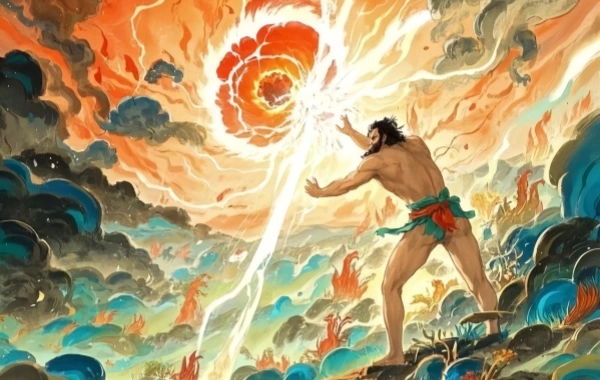
- Pangu Splits Heaven and Earth: First documented in the Three Five Calendar (Sanwu Liji) by Xu Zheng during the Three Kingdoms period (220–280 CE), its roots trace to Southern minority epics like the Miao Ancient Song. Pangu awakens in chaos, splits heaven and earth with an axe, and his body transforms into celestial bodies and landscapes—embodying the "unity of heaven and humanity."
-
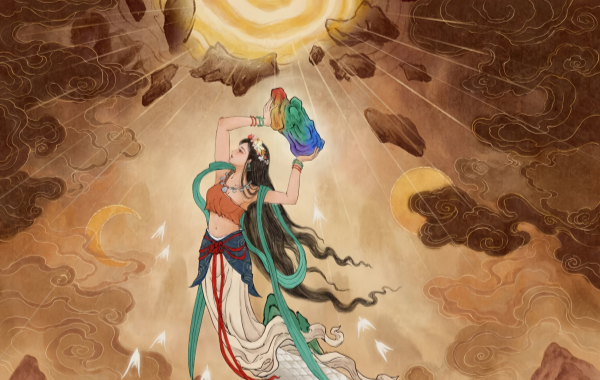
- Nüwa Creates Humans: Nüwa shapes humans from yellow clay, later switching to flicking mud with a vine due to exhaustion, explaining social hierarchies (hand-molded elites vs. vine-flung commoners). This reflects matrilineal reverence for female fertility.
- Nature Deity Worship
- Solar Deities Xihe and Changxi:
- Xihe drives the sun chariot across the sky, birthing ten suns (basis for Houyi's archery legend);
- Changxi governs the moon and its twelve phases, symbolizing agrarian reliance on cyclic time.
- Storm Gods: The one-legged Kui (resembling a bull) controls thunder through drum-beats (inspiration for Shang-Zhou bronze taotie motifs); Hebo (River Ber) rules The Yellow River but is dethroned by Yu the Great for flood mismanagement.
- Solar Deities Xihe and Changxi:

- Totemic Myths: Tribal Identity Symbols
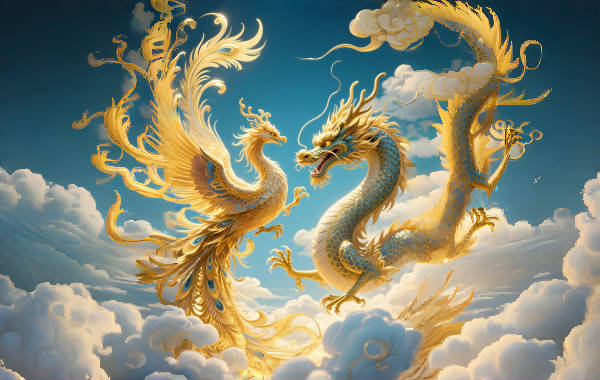
- Dragon Totem: A composite of snakes, crocodiles, and fish, symbolizing multi-ethnic unity. Artifacts like the Hongshan Culture's Jade Pig-Dragon (c. 4700–2900 BCE) and the Liyang West Water Slope Shell Dragon (c. 3300 BCE) serve as physical proof.
Read more:Nine Sons of the Dragon >>
-
- Phoenix Totem: Linked to solar worship, it became the Shang Dynasty's sacred bird (evident in bronze phoenix motifs) and later a symbol of royal consorts.
Archaeological Evidence:
- Yangshao Culture (5000–3000 BCE) pottery features fish, frog, and bird motifs hinting at totemic significance.
- Liangzhu Culture (3300–2300 BCE) jade cong with "shaman-beast" faces suggest rituals bridging humans and deities.
2. State Mythology Stage: Royal Legitimacy & Historical Reinterpretation (Shang—Han Dynasties, c. 1600 BCE—220 CE)
As state formations emerged, myths became tools for legitimizing royal power and regulating social order, adopting historical and ethical dimensions.
- The Five Emperors System: Epic of Tribal Alliances
- Huangdi (Yellow Emperor): Revered as the "Founding Ancestor of Culture," his battles against Chiyou and unification of central plains (per Records of the Grand Historian) symbolize the formation of the Chinese nation.
- Yao and Shun's Abdication: Idealized as "public-spirited" succession, providing Confucian moral exemplars while masking early tribal conflicts.
- Yu the Great's Flood Control: From Myth to History
- Primitive Version: Yu transforms into a bear to splitting mountains and leading rivers, with his wife Tushan turning to stone to birth Qi (founder of the Xia Dynasty)—rich in shamanic magic.
- Confucian Revision: By Warring States and Han periods, Yu is reimagined as a selfless sage who prioritized public welfare over family, diluting divine elements.
- Shang-Zhou Religious Synthesis
- Shang Dynasty: Worship of "Di" (Supreme Deity) who controls nature and royal fate, with divination via oracle bones.
- Zhou Dynasty: The concept "Heaven's Mandate is not eternal; virtue alone sustains it" (Shangshu) ties divine authority to moral governance, justifying feudalism.
- Qin-Han Mythology: Imperial Spiritual Architecture
- Qin Shi Huang's Fengshan Sacrifice: Emulating ancient rituals at Mount Tai to proclaim "heavenly mandate," merging myth with political authority.
- Han Wu Di's Immortal Quest: Elevates local deities like Queen Mother of the West to national status (e.g., depicted in Mawangdui silk paintings).
Textual Carriers:
- Myth fragments in Shangshu and Shijing; systematic compilations in Lüshi Chunqiu and Huainanzi; Sima Qian's Records of the Grand Historian incorporates mythic figures into imperial genealogies.
3. Religious-Philosophical Fusion Stage: Taoist and Buddhist Adaptations (Wei-Jin—Tang Dynasties, 220–907 CE)
Myths became vehicles for religious doctrine and philosophical expression, marked by Taoist localization, Buddhist Sinification, and folk belief systematization.
- Taoist Myths: From Alchemy to Immortal Tales
- Laozi's Mission to the West & the Supreme Moral Deity: Zhang Daoling founded the Five Pecks of Rice Daoism, deiifying Laozi as Taoist patriarch and claiming he traveled west to convert Buddhists—creating a Taoist-Buddhist rivalry narrative.
- Eight Immortals Legend: Originating in Tang Dynasty, featuring folk figures like Lü Dongbin and Iron-Crutch Li, embodying Taoist defiance of fate through self-determination.
- Queen Mother of the West's Transformation: From a ferocious goddess in Classic of Mountains and Seas to a banquet host in Mu Tianzi Zhuan, culminating in Han Wudi Neichuan where she becomes the celestial giver of immortality pills.
- Buddhist Myths: Localization & Folk Integration
- Guanyin's Gender Shift: From Male to Female Compassion
- Indian Prototype: Avalokitesvara, a male bodhisattva with regal attire (e.g., Gandharan sculptures), symbolizing wisdom-compassion unity.
- Sinification: By Tang Dynasty, Guanyin fully feminized into the "Great Compassionate Guanyin," merging with folk "child-giving deity" beliefs. Factors include Confucian maternal ideals, folk needs for a protective "mother" figure, and Tang aesthetic preferences for fuller figures (e.g., Willow Guanyin, White-Robed Guanyin).
- Case Study: Fish-Basket Guanyin: A Tang tale depicts Guanyin disguised as a fishmonger testing devotees, reinforcing her grassroots compassion.
- Muliang's Salvation & Zhongyuan Festival
- Indian Roots: The Ullambana Sutra recounts Muliang rescuing his mother from hungry ghost realm via Buddhist rituals.
- Chinese Adaptation: Emperor Liang Wu Di merged this with Daoist "Zhongyuan Earth Official" pardons, creating the Zhongyuan Festival (July 15th) with river lanterns, paper money burning, and Muliang opera—blending Buddhist karma with Confucian filial piety.
- Hell System: Ten Kings of Hell & Localized Justice
- Indian Influence: Buddhist texts describe hells governed by Yama, emphasizing karmic retribution without detailed judges.
- Chinese Innovation: Daoist "Mount Tai Underworld" merged with Buddhist hell, creating the Ten Kings system (e.g., Qin Guang King, Song Di King) and Meng Po's soup for memory erasure—detailed in folk morality books like Yuli Zhibao.
- Guanyin's Gender Shift: From Male to Female Compassion
Read more:Ten Kings of Hell >>
-
- Buddhist Deities as Folk Guardians
- Guan Yu's Buddhist Incarnation: As "Galan Bodhisattva" protecting temples after Zhiyi's vision; later dual roles as "Martial Saint" and "God of Wealth."
- Cloth Bag Monk & Maitreya: A Tang-era monk's prophecies and jovial persona inspired Maitreya's approachable "Future Buddha" image in temples like Lingyin.
- Buddhist Deities as Folk Guardians
- Folk Belief Systematization: Hierarchical Integration
- Chenghuang (City God): Evolved from Zhou-era "water ditch" deity to urban protector, with state officials conducting rituals (e.g., Han Yu's Sacrifice to Chenghuang) and Ming Dynasty official canonization.
- Land God: From Shang-era earth rituals to Tang-era humanized elders and Song-era paired Land Lord/Lady, symbolizing yin-yang balance.
- Trade Gods: Industry patron saints like Lu Ban (carpentry) and Sun Simiao (medicine) merged with religious rituals, becoming guild symbols by Ming-Qing periods.
4. Literary & Artistic Recreation: Myth as Cultural Metaphor
Post-Tang myths evolved into literary metaphors and artistic motifs, influencing poetry, drama, and fiction while preserving cultural memory. Examples include:
- Journey to the West (Ming Dynasty): Blends Buddhist, Daoist, and folk legends into a literary masterpiece.
- Strange Tales from a Chinese Studio (Qing Dynasty): Reimagines hell myths for social critique.
The Deep Logic of Religious-Philosophical Fusion
The Wei-Jin to Tang transformation was a "creative conversion" of external religions with local culture. Taoism absorbed Buddhist Reincarnation view and folk legends; Buddhism adopted Daoist hell frameworks and Confucian ethics; folk beliefs systematized into state-aligned hierarchies. These myths became cultural hubs connecting elite thought, popular faith, and state governance, laying the foundation for China's pluralistic cultural unity.
This millennia-long journey—from explaining natural chaos to embodying philosophical ideals—proves myths are not static tales but living symbols that evolve with civilization, bridging humanity's past, present, and future.




Contact Us
What Our Clients Say?





Ask us before you decide.
Unsure about a route, departure date or room option? Tell us what is holding up your plans. You will get a clear answer from our China-based travel team—no booking required.